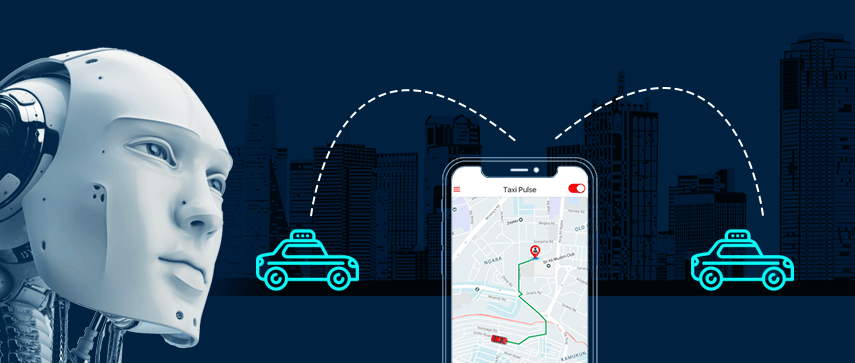
Artificial intelligence was merely a concept assimilated in the 1950s by the young British polymath who introduced artificial intelligence as a mathematical possibility. Making it more straightforward, artificial intelligence holds the ability to make machines perform tasks that showcase the replication of humans and animals.
We all are indeed undergoing a digital revolution, and everyone in the world is contemplating the AI-based process. The concept of AI might just be a mathematical theory, but currently, this AI has been ruling the Z Gen.This is one of the top reasons why every industry is getting more inclined towards the world influenced by artificial intelligence. Another surprising fact about the impact of AI on the taxi booking industry is that many giants have gone through tremendous growth in their businesses due to AI infiltration.
On the other hand we have also encountered a significant number of investments being made in the automotive industry. The majority of these investments are focused on artificial intelligence (AI) and self-driving technology improvement. In the meantime, new mobility systems and players are gaining traction in the car industry. Tesla is working to improve its autopilot system, Uber is experimenting with robo-taxis, and Google is working on self-driving vehicles.
The global market for AI in transportation is estimated to reach 3.5 billion dollars by 2023, according to estimates. Let’s take a quick look at some real-world AI applications in transportation.
AI in transportation: The applications
AI applications in transportation demonstrate why the market is booming and why businesses should utilise the technology. Take a look at the following examples of possible applications:
Vehicles that drive themselves
Autonomous vehicles are one of the most ground-breaking AI applications. Autonomous vehicles, which were previously only a sci-fi fiction, have now become a practical reality. Despite the fact that many people were suspicious of this technology during its early stages of research, driverless vehicles have already entered the transportation sector.
In Tokyo, self-driving taxis have already begun to operate. However, for safety reasons, the driver currently sits in the car to take control of the taxi in the event of an emergency.
Controlling traffic
Traffic congestion is another transportation issue that people confront on a daily basis. AI is now poised to fix this problem as well.
Sensors and cameras embedded in the road surface collect a massive amount of traffic data. This data is then transferred to the cloud, where big data analytics and an AI-powered system will be used to analyse and reveal traffic patterns. Data processing can provide useful insights such as traffic predictions.
Important information such as traffic forecasts, accidents, and road closures can be delivered to commuters.Furthermore, people can be notified of the shortest path to their destination, allowing them to travel without traffic congestion. AI may be utilised in this way to not only eliminate unnecessary traffic, but also to improve road safety and shorten commute times.
Predictions of delays
Flight delays are another pressing issue in today’s aviation. According to a study undertaken by experts at the University of California, Berkeley, the projected costs of aircraft delays in the United States are 39 billion dollars. Flight delays have a detrimental influence on passengers’ flying experiences, in addition to financial losses.
Negative flying experiences can devalue a transportation company’s value, resulting in higher client attrition rates. To address these difficulties, artificial intelligence (AI) comes to the rescue of the airline sector.
Taxis driven by drones
A drone taxi is one of the most intriguing and innovative AI uses in transportation. Pilotless helicopters offer a one-of-a-kind option for reducing carbon emissions, traffic congestion, and the requirement for costly infrastructure investment plans. Furthermore, drone taxis will allow individuals to get at their location considerably faster, reducing commuting time.
Furthermore, rising population pressures have put city planners under a lot of strain to ensure wise urban planning and infrastructure development while also conserving scarce resources. Drone taxis may be the true solution to all of the issues that these city planners are attempting to address.
Benefits of AI-Powered on Demand Services Like Taxi Apps
In the cab-hailing and transportation industries, startups are using AI to create smarter systems. In the shape of an AI-enabled taxi dispatch software, one significant application case has arisen.
A taxi dispatch system with artificial intelligence (AI) could be a game-changer. It enables startups to improve operational efficiency while also promising a better consumer experience.
Artificial Intelligence (AI) Enables Smart Business Decisions
With the support of data-driven analytics, business operators may make wise and well-informed decisions. It performs a quick, accurate, and comprehensive analysis of past trends based on client behavior and service demand. Following that, they can use AI technology to make business decisions based on trends.
Furthermore, you can employ predictive analysis to give recommendations to your consumers. An important factor to consider when it comes to making income from on-demand service apps.
App Personalization for a Better User Experience
What separates an average on-demand service app from a very successful one is the ability to customize apps to meet the needs of clients. It allows consumers to easily customize the information, material, and special offers they receive based on their needs. Business operators, on the other hand, have complete control over the user’s location, active time, and information about the platform’s most popular users.
Using such vital information, company owners can send unique offers to users during times when they are most active, hence increasing user involvement with the app.
Smart Driver Onboarding Process
It is true that with the help of AI-based services, the level of automation and convenience is reaching new heights. Combining artificial intelligence and taxi dispatch solutions brings out an impressive experience for the operators enabling them to create and deliver a fantastic onboarding process for drivers.
There are multiple ways AI can be integrated into the taxi dispatch page, such as chatbot, training modules providing real-time support for familiar driver drivers, or whenever stuck with an issue in the app.
Conclusion
In the end, we all can see how AI has been empowering each industry and especially the impact of AI on taxi dispatch systems. Even though there have been some amazing inventions, you need to know that we have only gone through the surface of AI, and there is way more than that waiting to be explored yet.
The cases, as mentioned earlier and benefits, are just a glimpse of possibilities and opportunities that are yet to be discovered. Buck up your seatbelts, as this is just the start of AI ignition.
Leave a Reply